
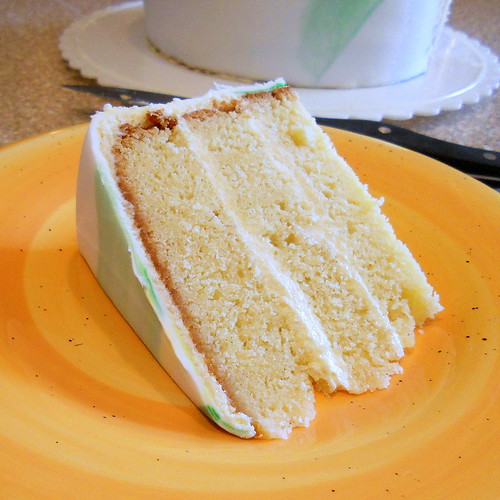
 This recipe is from Rose Levy Beranbaum’s The Cake Bible. It rocks. The genoise and the book.
If you’re unfamiliar with genoise, it is a very light, very dry French type of sponge cake. As you’ll notice in the recipe, there is very little fat in a genoise (and even the beurre noisette is not strictly called for, so you can leave that out if you’d like).
It absolutely needs to be soaked with a soaking syrup/simple syrup to make it moist. Once you soak it, you’ll be really happy you made a genoise.
***When mixing, don’t scrimp on those 5 minutes the recipe calls for–your only leavening is the bubbles you’re creating while mixing, so if you don’t mix enough, your genoise will be dense.
What You’ll Need
- 1.25 oz. clarified beurre noisette (browned butter)
- 1 teaspoon vanilla
- 7 oz. whole eggs (about 4 eggs)
- 3.5 oz. sugar
- 1.75 oz. sifted cake flour
- 1.75 oz. cornstarchSyrup for soaking
- 2 oz. sugar
- 4 oz. water
- 1 oz. liqueur of your choice
Spray an 8″ or 9″ pan with pan spray, line the bottom with parchment, and spray again.
Sprinkle in some flour, roll it around so it covers and sticks to the pan spray, then tap out the excess.
You might as well brown a whole bunch of butter and keep it in the freezer.
In a large sauce pan, melt 1 pound (4 sticks) butter over medium heat. Let the butter boil butter until the milk solids fall to the bottom and begin to brown. You want them to be a deep golden brown color. If possible, use a pan with a white interior so you can get a good look at the color of the solids.
The butter will smell nutty and wonderful. Pour through a very fine mesh strainer, or through a strainer lined with a couple of layers of cheesecloth.
Weigh out your 1.25 oz. for the genoise and freeze the rest after it comes to room temperature.
For the Genoise (Review The Egg Foam Method)
In a large mixing bowl set over a pan of simmering water, heat the eggs, sugar and vanilla until just lukewarm, stirring constantly.
Place the bowl on your
Remove about 3/4 cup egg mixture and whisk in the warm-and-liquid-but-not-scalding-hot beurre noisette.
Sift half the flour mixture over the remaining eggs and fold in gently but thoroughly. You’re trying to minimize loss of volume here, so be gentle.
Repeat with rest of flour, then fold in the butter mixture.
Pour batter into prepared pan, smooth the top, and bake at 350 degrees, F without opening the oven, until the cake is golden brown and the cake starts to shrink away from the sides of the pan a bit. This should take between 25 and 35 minutes. No need to jab a skewer into it–shrinkage=done. If you must peek, wait the minimum of 25 minutes, or your cake might fall.
Loosen cake from sides of pan and turn it out on a rack to cool upright. When ready to use, trim top and bottom crusts (they should just about peel off) and sprinkle with the syrup. The cake is very fragile once sprinkled, so take care in moving it–use a cake spatula or cake circle.
For the syrup: bring the sugar and water to a rolling boil, stirring constantly. Cool to room temperature and add in your liqueur (you can use vanilla extract, if you want).




Tax_Pro_Pam says
I made the mistake of attempting a genoise without checking here first. It was tough. Thanks to you, I know what I did wrong. I didn’t whip the eggs long enough. Once again, thank you for your knowledge and solving the mystery of my baking mishaps. I should have known better than to rely on the knowledge of another blogger who doesn’t quote Shirley Corriher… 🙂
Jennifer Field says
Glad my post was there to help, Pam! And, when it comes to baking science, I will never not quote Shirley Corriher! 🙂
Sarah says
Hello,
So did you make this recipe x3 for the picture above? How long should I let the syrup absorb before serving? I am trying to replicate my favorite cake- a vanilla genoise with vanilla bean mousse finished with a buttercream so if you have any advice I would greatly appreciate it!
Thanks!
Jennifer Field says
Hi, Sarah!
The cake you see in the photo is one recipe cut into 3 layers. If you’re going to make a larger batch, I’d still make it in this amount and just bake 2 cakes. Foam cakes don’t double well.
Place the layers before adding the syrup, because once you add it, the layers will be very delicate and almost impossible to move without tearing. I would add the syrup and frost the cake at least 4 hours before you plan to serve it. If you’re using a frosting that needs to be refrigerated, bring the cake out and cut servings a good 30 minutes-45 minutes before you want to serve them so the frosting can soften up.
BG says
Hello-
1 teaspoon vanilla is listed in the ingredients, but not in the recipe for the cake. Is it for the cake or the soaking syrup?
Jennifer Field says
Good catch, BG–I just updated the recipe. Yes, add the vanilla with the eggs and sugar in the first step.
Chrisi Stockdale says
Can I use ghee instead of the brown butter?
Jennifer Field says
You absolutely can. It won’t have the same nutty flavor, but it will definitely give you the texture you’re looking for, Chrisi.
stephen king says
hi quick quirk about your description, a Genoise is italian not french & is from Genoa hence the name as a patisserie specialist myself i just thought i should let you know its wrongly described but a good Genoise should be light fluffy & moist after being made not dry so if thats the case your either not putting enough air into it when whisking your eggs butter & sugar which should be done over heat or your knocking to much air out when stiring in your flower, lso that isn’t a gtrue Genoise recipe
Jennifer Field says
I will concede that it’s an Italian sponge (although named in French). But, they are dry cakes as they are very lean–some contain only the fat in the egg yolks, and some only add an extra ounce or two of browned butter at the end. Either way, when baked as rounds and not as thin sheets for jelly roll, they are almost universally brushed with a flavored syrup to bring both extra flavor and tenderness. Without that, a genoise is rather dry, regardless of how high it rises.
Efe says
you bake the cake and then decorate the next day … how do you store that cake until next day berfoe decorating? At room temperature inside a box without ventilation? Or inside refrigerator? Have you also tried freezing and thawing cakes berfoe decorating them? You think that works well and doesn’t spoil the cake texture & taste?Lots of questions I know, but I’ve been following your blog since a long time and felt you’re quite an expert and can help answer a beginner’s curious questions! Khob khun kha ^_^
Jennifer Field says
Yes, I usually decorate the next day, Efe. I generally wrap the genoise well and freeze it. I have also left them, again well wrapped, on the counter at room temperature. After torting and placing layers, I brush them well with syrup to add flavor and moisture. I’ve never had a cake suffer from being frozen and then thawed. It is often easier to slice layers in half when the layers are cold, so if you’ve not tried it before, I think you’ll be pleased with the results.
Queenie says
Hello! Great informative site, and i love the detail you go into, especially concerning egg foam cakes. I have one question concerning whole egg sponges. Particularly with asian sponge cake recipes, i have seen “whole egg”sponges made with egg whites beaten seperately first, then with yolks mixed in with whites before incorporation of other ingredients. How would this differ in texture from ordinary whole egg sponges? Many thanks!
onlinepastrychef says
Hi there, and I’m very glad that you like the site!
The only reason I can think of to whip the whites and then incorporate the yolks at the end (yolks whipped too, yes?) is to create a cake that holds together better than a genoise. I make lady fingers this way. I whip the yolks with half the sugar, whip the whites w/the other half of the sugar, add the yolks to the whites and then sift the dry over all and fold gently. This gives me a cake that holds syrup well and doesn’t become to delicate when soaked that you can’t move or roll it. A genoise, based on a whole egg foam, becomes delicate and can crack/break/crumble if you try to move the layers once they are soaked. Separating the two foams until the end allows for the whites to provide a really firm structure (since they weren’t emulsified w/the lecithin in the yolks during whipping). I can actually soak and then gently squeeze a lady finger to “wring out” the extra syrup without its falling apart. If you’d like to watch my lady finger hangout (live demo) here’s the YT video: http://www.youtube.com/watch?v=h1AGmhd8-oc
Aniqah says
What icing did you use on the cake?
onlinepastrychef says
In this particular case (in the photograph), I used a thin layer of standard buttercream (American style w/powdered sugar) and then covered the cake with rolled fondant. If not using fondant, my preference is for a French or Italian buttercream. The light, smooth syrup-based frostings pair particularly well with the delicate, syrup-soaked cake.
Adrian says
For a 9″ pan how tall should the genoise be once baked?
onlinepastrychef says
If you have properly whipped the batter, it should measure about an 1 to 1 1/4″ tall *after* you remove the top and bottom crusts, @2ad76f17e1955fe27b98eed22a886584:disqus . Honestly, I think it is much more important to remove the top crust than the bottom. The top crust is, well, crusty and kind of hard like a cookie. The syrup has a hard time soaking in which is why it needs to be removed. Plus, for looks, the crust is a darker color than the cake and won’t look nice once you cut the cake.