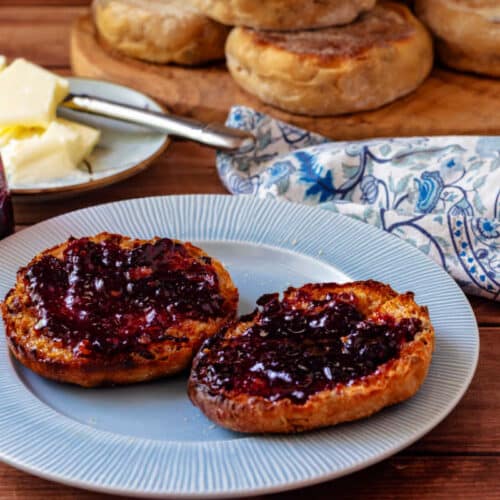
Cinnamon Raisin English Muffins
If you've never had a truly homemade English muffin, you're in for a treat. These bakery-style cinnamon raisin English muffins are tall, tender, and packed with warm cinnamon and juicy raisins. Toast one, slather it with butter, and don't be surprised if you skip the English muffin aisle at the grocery store.
Servings 12 English muffins
Calories 258kcal
Ingredients
- 180 grams raisins 6.3 oz or 1 1/4 cups, soaked for 15 minutes in enough boiling water to cover
- 500 grams all-purpose flour 17.6 oz or 4 cups + 2 Tbsp, King Arthur preferred for its higher protein content
- 60 grams dark or light brown sugar 2.1 oz or 1/4 cup + 1 Tbsp, packed
- 30 grams dry milk powder 1.1 oz or a slightly generous 1/4 cup
- 8 grams instant yeast 2 1/2 teaspoons, sub active dry, if you prefer
- 360 grams water 12.7 oz or 1 1/2 cups + 1 Tbsp, room temperature
- 42 grams melted butter 1.4 oz or 3 Tbsp
- 1 Tbsp ground cinnamon
- 20 grams maple syrup 1 Tablespoon
- 10 grams kosher salt 1 3/4 teaspoons of Morton's or 1 Tablespoon Diamond Crystal
For Shaping and Cooking
- fine cornmeal sub semolina if you prefer
- vegetable oil
Instructions
For the Dough
- Drain and blot the soaked raisins and spread them out on 2-3 layers of paper towel or on a lint-free kitchen towel to cool.
- In the bowl of your stand mixer, combine the flour, brown sugar, yeast, and dry milk powder. Set aside.
- Measure the water, and stir in the salt so it dissolves.
- Stir the cinnamon into the melted butter to make a slurry.
- Pour the butter/cinnamon mixture into the water.
- Add the liquid to the dry ingredients and fit the dough hook onto the mixer.
- Mix on low speed for a couple of minutes, scraping down to the bottom of the bowl a couple of times, until you have a shaggy, thick batter.
- Increase speed to medium and knead for 17 minutes. The dough will be very wet and won't clear the sides--and certainly not the bottom--of the bowl, but you will see it become more cohesive and stretchy. It's fine.
- After 17 minutes, turn off the mixer, add the raisins (or other dried fruit), and mix on low-to-medium-low speed for 3 additional minutes.
- During those 3 minutes, use your hand to spread a little neutral vegetable oil out on your work surface.
- While the dough is resting, cut a piece of parchment paper into 12 squares and arrange them 3 x 4 on a half-sheet pan.
- Liberally sprinkle fine cornmeal or semolina onto each square, and set aside.
Shaping the Muffins
- Use a bowl scraper or spatula to scrape the sticky dough out onto the oiled surface.
- Rub a little oil onto your hands and pat the dough out into a rough rectangle.
- To ensure an Even Raisin Distribution, using your bench knife, fold the dough into thirds, first one way and then the other.
- Oil your hands a little more, and shape the dough into a smooth ball. Plop it back into the mixer bowl, brush the exposed surface with vegetable oil, cover, and allow to rise in a cozy place for an hour. The dough will not double, and it may flatten out a little bit. It's fine. This is a very slack dough and doesn't follow the "regular" rules. NOTE: don't clean off the work surface. You want a little oil left for the final shaping.
- After the hour is up, scrape the dough back onto your work surface. Oil your bench knife and divide the dough into 100 gram pieces. NOTE: For the most consistent size, weigh the entire amount of dough and divide by 12 (or 6 if making a half batch).
- Working with lightly oiled hands and with one piece of dough at a time, gather each piece into a ball with a smooth top and then tighten by moving the dough between your hands on the counter. This will provide enough friction to smooth out the balls and allow them to rise evenly. Place each ball on one of the squares of parchment. At this point, the proto-muffins will measure about 2 1/2" / 65mm in diameter.
- Spray the tops of the balls with some oil or pan spray, cover with plastic wrap, and let sit in a cozy place for an hour. Then allow them to sit out at room temperature for about 30 minutes. The diameter should now be between 3 1/4"-3 1/2" / 85 - 90mm. During the 30 minutes at room temp, preheat the oven to 325°F / 163°C. Place a parchment-lined half-sheet pan on the center rack.
To Griddle and Bake
- Preheat a large cast iron skillet (or two, to make the work go faster) over medium low heat for 10-15 minutes.
- Brush about 2 teaspoons vegetable oil in the pan and wipe out any excess.
- Working in batches of 3 and keeping the rest of the muffins covered, gently tip the risen muffins into the skillet, leaving at least 1/2" between them. Let them quietly and gently sizzle in the griddle for 5 minutes. If you'd like, use a pastry brush to brush excess cornmeal off the tops. NOTE: Some of the muffins may split a little bit on the tops while the first side is cooking. It's okay--once you griddle the second side, you won't ever know, and it will not affect the texture of the finished muffins.
- After 5 minutes, use a spatula to carefully flip each muffin. Cook for an additional 5 minutes.
- Use a spatula to transfer the griddled muffins to the baking sheet in the oven and bake for 5-10 minutes, or until the internal temperature of each muffin is 195-200°F / 90 - 93°C. Remove the English muffins to a cooling rack.
- Repeat with the remaining muffins in this manner: griddle 5 minutes → flip and griddle 5 more minutes → bake 5-10 minutes → check internal temperature → cool.
- Allow muffins to cool to room temperature before splitting, toasting, and devouring. For best texture, wrap them in a lint-free towel and let them sit at room temperature overnight before splitting and toasting. Store leftover muffins in a zip-top freezer bag with as much air pressed out as possible. When hunger strikes, thaw for a few seconds in the microwave before splitting with a fork and toasting.
Notes
Ingredient Substitutions
- Substitute 360 grams (12.7 oz or 1 1/2 cups + 1 Tbsp) whole milk for the water. Leave out the dry milk powder.
- Substitute 34 grams vegetable oil for the 42 grams of butter. No other changes needed.
- Substitute any other dried fruit or mixture of dried fruits for the raisins.
- Instead of using water to soak the raisins, don't discount using apple juice, tea, coffee, ginger ale, etc for the soaking liquid. Just bring it to a boil and proceed as directed.
Two-Day Schedule
Here's how to split up the work to make English muffins over two days:- Day One: In the early evening to evening, make the dough, let it proof for an hour, shape the muffins, and put them on their cornmeal dusted parchment landing pads. Spray the tops with a little pan spray, cover with plastic wrap, and refrigerate overnight
- Day Two: The next morning, remove from the fridge. They will look like they have barely risen. All is well. Allow them to sit in a cozy place for about an hour, then heat your oven and griddle and proceed with the cooking instructions as written.
To Make 6 English Muffins (1/2 Recipe)
- 90 grams raisins 3.2 oz or scant 2/3 cup, soaked for 15 minutes in enough boiling water or other boiling liquid to cover
- 250 grams all-purpose flour 8.8 oz or 2 cups + 1 Tbsp, King Arthur preferred for its higher protein content
- 30 grams dark or light brown sugar 1.1 oz or 2 Tbsp, packed
- 15 grams dry milk powder 0.5 oz or a slightly generous 2 Tbsp
- 4 grams instant yeast 1 1/4 teaspoons, sub active dry if you prefer
- 180 grams water 6.3 oz or 3/4 cup + 2 teaspoons, room temperature
- 21 grams melted butter 0.7 oz or 1 1/2 Tbsp
- 1 1/2 teaspoons ground cinnamon
- 10 grams maple syrup 2 teaspoons
- 5 grams kosher salt scant 1 teaspoon Morton's or 1 1/2 teaspoons Diamond Crystal
Recipe Notes
- Don't add extra flour. This dough is intentionally very soft. Resist the urge to add flour to the mixer or your work surface. A little oil on your hands and counter is all you need.
- Split with a fork, not a knife. For the best nooks and crannies, work the tines of a fork around the outside until the muffin pulls apart naturally.
- Toast before serving. Even if the muffins are fresh, toasting crisps the exterior and brings out their full flavor and texture. They really shine after a trip through the toaster.
- Freeze for later. Once completely cool, freeze the muffins whole in a zip-top freezer bag for up to 1 month for best flavor/texture. Thaw at room temperature or for a few seconds in the microwave. Fork split, and then toast before enjoying with plenty of butter and jam.
- A little misshapen is perfectly homemade. Since these are hand-shaped rather than cut with rings, a muffin or two may be slightly oval or rustic looking. They'll still rise tall, toast beautifully, and taste exactly as they should.
Nutrition
Calories: 258kcal | Carbohydrates: 52g | Protein: 6g | Fat: 3g | Saturated Fat: 2g | Polyunsaturated Fat: 0.3g | Monounsaturated Fat: 1g | Trans Fat: 0.1g | Cholesterol: 8mg | Sodium: 367mg | Potassium: 234mg | Fiber: 3g | Sugar: 7g | Vitamin A: 144IU | Vitamin C: 1mg | Calcium: 57mg | Iron: 2mg