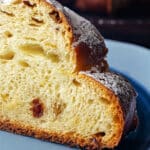
Houska
Houska, an enriched, fruit-filled Czech celebration bread, has a soft, feathery crumb and is simply yet beautifully spiced with lemon zest and mace. It takes a bit of work to make, but I will walk you through all the steps so you can approach this bread with confidence. Thanks again to reader Adrienne who requested this recipe.Remember that all ounce measurements are by weight. If you have any questions about any of the steps, please review the making the dough section in the post. I go into great detail there so that you can achieve the best results possible.
Servings 12 slices
Calories 304kcal
Ingredients
For the Houska Dough
- 15.6 oz all-purpose flour, divided use 443 grams or about 3 1/2 cups measured by whisking, spooning, and sweeping
- 8.5 oz whole milk, scalded to 185F and cooled to 125F 241 grams or 1 cup and 1 Tablespoon
- 2.8 oz granulated sugar 79 grams or a slightly generous quarter cup
- 2 tsp kosher salt 10 grams. I use Morton's. If using measuring spoons, use 2 teaspoons Morton's or 3 teaspoons of Diamond Crystal.
- 1 ½ tsp active dry or instant yeast 5 grams. I use instant yeast
- 1 egg at room temperature
- zest of 1 small-to-medium lemon
- ¼ tsp mace a generous 1/8 teaspoon if substituting nutmeg
- 4 oz golden raisins, plumped in boiling water for 10 minutes, drained, and patted dry. *Reserve some raisin soaking liquid. You might need it 112 grams or 3/4 cup
- 1.5 oz sliced almonds, optional 43 grams or 1/2 cup
- 4 oz softened, unsalted butter 1 stick or 112 grams
For the Egg Wash
- 1 whole egg
- pinch kosher salt
- 1 tsp water
Instructions
- Check your scalded milk to make sure it is no more than 125°F / 52°C. Weigh it to see if you lost any volume. If so, add some *reserved raisin soaking liquid until you have 8.5 oz. I needed an extra tablespoon of liquid.
- In a large mixing bowl, combine the scalded milk, 10 oz / 284 grams all-purpose flour, sugar, salt, and yeast and whisk until you have a pancake batter-like consistency.
- Whisk in the egg, lemon zest, and mace.
- Cut the soft butter into pieces and add to the bowl of your stand mixer with the remainder of the flour.
- Attach the paddle attachment and mix on speed 1 or 2 until the butter is evenly distributed throughout and no large pieces remain, about 3 minutes.
- Tip in the batter, scraping the bowl well, then swap the paddle for the dough hook.
- Mix on low speed until there is very little loose flour remaining, about 2 minutes. The dough will be quite shaggy and messy at this point.
- Turn the speed up to medium (4-5), and knead for 9 minutes. Don't worry if the dough seems too soft. Trust the process.
- Stop the mixer and add the raisins and optional almonds. If using almonds, reserve a small handful to put on top of the loaf after shaping.
- Knead on medium speed (4-5) for an additional 5 minutes. At this point, the dough should be mostly clearing the sides of the bowl, even if a little still sticks to the bottom. Thanks, gluten!
- Oil or spray your hands with pan spray. Gather up the soft, shiny dough, and form it into a smooth ball, and plop it back into the mixing bowl. Spray or oil thoroughly, cover with plastic wrap, and refrigerate overnight, or for at least 8 hours. It can easily go as long as 36 hours in the fridge, so it's pretty forgiving. I let mine cold ferment for 12 hours.
Shaping and Baking
- Remove the dough from the fridge. It will be pretty stiff. That's okay. It'll be easier to work with, and it will soften up/warm up as you work with it.
- Divide the dough into 3 or 4 large pieces, 3 medium pieces, and 2 small pieces. Don’t stress about perfect sizing—just aim for small orange-sized pieces for the large ones, medium lemons for the middle, and small limes for the smallest.
- Roll each piece of dough into a log about 8" long, keeping the same-sized pieces together. Then roll each 8" log into an approximately 16" rope. No need to be super exact. I used my bench knife, which is 6" long, to check, approximating 16".
- Braid the 3 (or 4) larger ropes, pinching the ends together so they don't separate. Press it down so it flattens and widens just a bit.
- Braid the 3 medium ropes into a 3-strand braid, pinching the ends well. Center it on the largest braid and press them together with cupped hands.
- Twist the two smallest ropes together, pinching the ends, and center it on top of the 3-strand braid. Use your cupped hands to press them together.
- Insert several skewers or long toothpicks through the braided layers to help keep everything in place during the rise and bake. To avoid noticeable holes, insert them where the ropes intersect.
- Spray with pan spray or brush with neutral oil, cover with plastic wrap, and let rise in a cozy place until noticeably puffy, larger, and a little jiggly when you gently shake the baking sheet. This will take anywhere from 1 1/2-2 1/2 hours. depending on conditions in your kitchen.
- During the last 30-45 minutes of the rise, heat the oven to 350F with a rack in the center. Whisk the egg wash ingredients together.
- When the houska is nicely light and risen, brush gently but thoroughly with the egg wash. You can even use two coats to make sure you have a nice, even layer of egg wash on the bread. If using sliced almonds, sprinkle the ones you reserved down the center of the bread.
- Bake for 30-35 minutes, rotating the baking pan after 20 minutes to ensure even browning. At this point, the loaf should be beautifully golden brown.
- Tent the bread with foil and continue baking until an instant read thermometer reads 195°F / 91°C, an additional 10-20 minutes.
- When the braid reaches the target temperature, remove from the oven. Slide the houska onto a cooling rack and allow it to cool completely. This could take 2-3 hours.
- Once completely cool, you may leave it as is, drizzle it with a powdered sugar and milk glaze, or dust it with powdered sugar. I chose option C, but there is no one right way.
- Serve as is or toast it to serve with butter and jam. Keep the remainder of the loaf at room temperature for 2 days. Slice and freeze in a zip top freezer bag for longer storage. Enjoy!
Notes
Helpful Reminders
- The dough will be soft and a bit sticky at first. Don’t add extra flour—trust the process. It will smooth out and strengthen with kneading. Adding more flour will just result in a denser loaf that won't rise as well.
- The dough will begin to clear the sides of the bowl after extended kneading (around the 11–12 minute mark). Be patient—this is where the structure develops. For this bread, that happens after adding the raisins and optional almonds.
- If the dough shrinks back while rolling the ropes, let it rest for 5–10 minutes to let the gluten relax, then continue.
- The shaped loaf should be noticeably puffy and a little jiggly before baking.
- This bread browns quickly. Tent loosely with foil as needed and bake to an internal temperature of 195°F/91°C.
Nutrition
Calories: 304kcal | Carbohydrates: 45g | Protein: 7g | Fat: 11g | Saturated Fat: 6g | Polyunsaturated Fat: 1g | Monounsaturated Fat: 4g | Trans Fat: 0.3g | Cholesterol: 50mg | Sodium: 409mg | Potassium: 193mg | Fiber: 2g | Sugar: 13g | Vitamin A: 309IU | Vitamin C: 0.3mg | Calcium: 52mg | Iron: 2mg