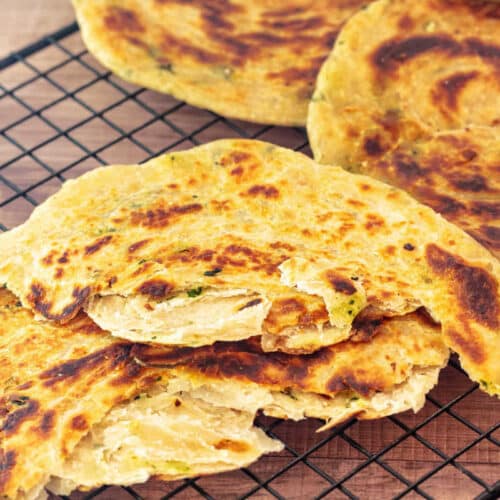
Flaky Layered Skillet Flatbread
These flaky layered skillet flatbreads are crisp, chewy, tender, and almost endlessly customizable. Season them to match whatever you're cooking, then serve them warm for tearing, scooping, and generally making an otherwise ordinary meal feel like an Event.
Servings 6 6" flatbreads
Calories 206kcal
Equipment
Ingredients
For the Dough
- 256 grams all-purpose flour 9 oz or about 2 cups, King Arthur preferred
- 1 teaspoon granulated sugar
- ½ teaspoon baking powder
- 170 grams hot water (165-170°F / 74-77°C) 6 oz or 3/4 cup
- 2 teaspoons apple cider vinegar or white vinegar
- 3 grams kosher salt slightly generous 1/2 teaspoon of Morton's or 1 teaspoon Diamond Crystal
For Layering
- 28 grams fat (ghee, oil, bacon fat, etc) 1 oz or 2 Tablespoons, plus a little more for stacking
- 2 teaspoons all-purpose flour plus a little more for sprinkling
Seasoning Options
- minced herbs, citrus zest, spices, Microplaned hard cheese, etc. a total of no more than 1/2 teaspoon of herbs/spices/zest and no more than 8-9 grams of Microplaned cheese per flatbread. Restraint is the order of the day.
Instructions
To Make the Dough
- In the bowl of your stand mixer or in a large mixing bowl, combine the flour, sugar, and baking powder and whisk well to combine.
- In a small bowl, add the apple cider vinegar and salt.
- Bring your water to a boil and then pour 170 grams into the vinegar and salt.
- When it cools to 165-170°F / 74-77°C, pour it into the dry ingredients.
- Mix with the dough hook or with a spatula if making by hand until you have a shaggy dough and most of the dry ingredients are moistened.
- Knead on medium speed or by hand, working the dough between your fist and the inside of the bowl, for 15 minutes. Dough will be fairly smooth, a little sticky, and not very stretchy.
- Cover the dough with plastic wrap by pressing it directly onto the dough and tucking it in so it doesn't dry out. Let the dough rest for 1 hour.
Initial Shaping
- While the dough is resting, mix the 28 grams/1 ounce/2 Tablespoons of fat and 2 teaspoons of all-purpose flour together and set aside. Make sure the mixture is spreadable. If using a fat that tends to solidify at room temperature, put it in the microwave for a few seconds to make sure you can spread it.
- After the rest, weigh the dough and divide it into 4, 6, or 8 equal pieces. I think the sweet spot for a single serving is to divide it into 6 pieces, but it will work regardless.
- Shape each portion of dough into a rough ball and cover with plastic wrap to prevent drying. Make sure it's a fairly large piece or wrap, because it will be doing a lot of work over the next few steps.
- Working with one piece at a time on a very lightly floured surface--scantily floured, even--roll each piece into a flat-ish disc about 3-6" in diameter depending on what size flatbread you are making.
- Rub or brush about 1/2 teaspoon of fat onto each round and then sprinkle on about 1/2 teaspoon all-purpose flour. Stack the discs as you go, and cover them with your trusty piece of plastic wrap.
- Flip the stack of discs upside down to work with the first one you made.
- On a clean, dry surface, and working with one piece at a time, roll out into an Extremely thin, vaguely rectangular shape. It should be so thin you can see the countertop through it. It won't snap back much because the dough is well rested, and the clean counter gives you enough friction to help roll it paper thin.
- Lightly brush the surface of the dough with about 1 teaspoon of the fat/flour mixture.
- Using a light hand, sprinkle on your preferred seasonings. Remember, we're not stuffing, we're building seasoned layers. Go easy.
Building in the Layers
- Roll up the dough into a cigar and place it under the plastic wrap. Repeat with the other discs of dough.
- Once you have rolled all your cigars, work with one at a time and stretch or roll it so it is 2-3 times longer than it was when you started. I like to roll lightly against the counter, moving my hands away from each other as I roll. And for fun, you can use a great technique used to make some Asian noodles: the bounce stretch. Hold the dough at either end and bounce it lightly against the counter as you move your hands farther apart.
- Coil the long snake of dough into a round, making sure the loops touch and being careful not to twist the rope as you coil it.
- Press the coil of dough flat with your palm, and cover while you shape the rest of your dough.
Cooking the Flatbread
- Preheat your cast iron skillet (or other pan--nonstick is fine) over medium heat for 5 minutes. It may take less time with a lighter pan. NOTE: If baking from frozen, heat the pan over medium-low heat for 5 minutes and then increase the heat once the dough has completely thawed.
- Working with one disc of dough at a time, roll it out into a circle, flipping the dough over several times. It will want to cup up at first, but be patient and keep rolling it. You will prevail. If making 6 flatbreads, roll the dough into about an 8" round.
- Place the dough into the dry, heated pan and let cook for about 30 seconds without pressing down.
- Flip the dough every 30-45 seconds, pressing down firmly, especially concentrating on the center of the bread and on the edges to ensure even cooking.
- After about 5 minutes of cooking/flipping/pressing, the dough should be an evenly-spotted golden brown. Add about 1 teaspoon of fat of choice--NOT the fat mixed with flour--and lift the bread and tilt the pan so the fat can coat the surface.
- Let the bread sizzle and puff for about 20-30 seconds per side, and it's done! Total cooking time is between 5-7 minutes or about 8-9 minutes if cooking from frozen. Place on a cooling rack and move onto the next bread.
- I move the skillet off the heat and turn off the burner between breads so the pan doesn't overheat and smoke. You should do the same. Continue cooking/flipping/pressing/sizzling and stacking the bread until it is all done.
- Once the flatbreads are cool enough to handle, scrunch each one a bit to loosen up the layers and make the bread flexible. Serve and enjoy!
Notes
1. Hot water doughs are supposed to feel different.
This dough starts out rougher and stickier than many bread doughs because the hot water gelatinizes some of the starches in the flour. Trust the knead. Trust the one-hour rest. The dough transforms dramatically. 2. Resist the urge to over-season.
A little seasoning goes a long way. Because the herbs, spices, zest, and cheese are rolled into thin layers and then concentrated during shaping, less is usually more. 3. Tears and breaks are not a problem.
If the dough tears while rolling or a rope breaks while stretching, simply continue with the recipe. Once coiled, flattened, and cooked, small imperfections disappear into the layers and they will cook up just as perfectly as your untorn, unbroken spirals. Promise. 4. Flip and press aggressively.
Unlike many breads, these flatbreads benefit from frequent flipping and pressing during cooking. This ensures even browning, encourages the layers to separate, and prevents undercooked spots in the center. Once you add the fat during the last minute or so of cooking, stop pressing to allow the oil's heat to puff the breads up a little bit. 5. Don't skip the scrunch.
Before serving, gently bend and scrunch each flatbread a few times. This encourages the layers to separate, making the bread flakier, more flexible, and easier to tear and scoop. You can also let everyone scrunch their own. Who doesn't love audience participation?
This dough starts out rougher and stickier than many bread doughs because the hot water gelatinizes some of the starches in the flour. Trust the knead. Trust the one-hour rest. The dough transforms dramatically. 2. Resist the urge to over-season.
A little seasoning goes a long way. Because the herbs, spices, zest, and cheese are rolled into thin layers and then concentrated during shaping, less is usually more. 3. Tears and breaks are not a problem.
If the dough tears while rolling or a rope breaks while stretching, simply continue with the recipe. Once coiled, flattened, and cooked, small imperfections disappear into the layers and they will cook up just as perfectly as your untorn, unbroken spirals. Promise. 4. Flip and press aggressively.
Unlike many breads, these flatbreads benefit from frequent flipping and pressing during cooking. This ensures even browning, encourages the layers to separate, and prevents undercooked spots in the center. Once you add the fat during the last minute or so of cooking, stop pressing to allow the oil's heat to puff the breads up a little bit. 5. Don't skip the scrunch.
Before serving, gently bend and scrunch each flatbread a few times. This encourages the layers to separate, making the bread flakier, more flexible, and easier to tear and scoop. You can also let everyone scrunch their own. Who doesn't love audience participation?
Nutrition
Calories: 206kcal | Carbohydrates: 34g | Protein: 5g | Fat: 5g | Saturated Fat: 4g | Polyunsaturated Fat: 0.3g | Monounsaturated Fat: 1g | Cholesterol: 1mg | Sodium: 218mg | Potassium: 83mg | Fiber: 1g | Sugar: 1g | Vitamin A: 10IU | Calcium: 38mg | Iron: 2mg